Screen-level approach
The initial concept explores working through the visible interface rather than depending on early EMR API integration.
Technical feasibility, configuration needs, and workflow fit would still require validation at each site.
HayanMind presents FreeDoc
FreeDoc is an early-stage concept for supporting claim administration alongside the EMR clinics already use. We are exploring how local AI could interpret visible screen context, surface relevant guidance, and prepare administrative next steps for human review.
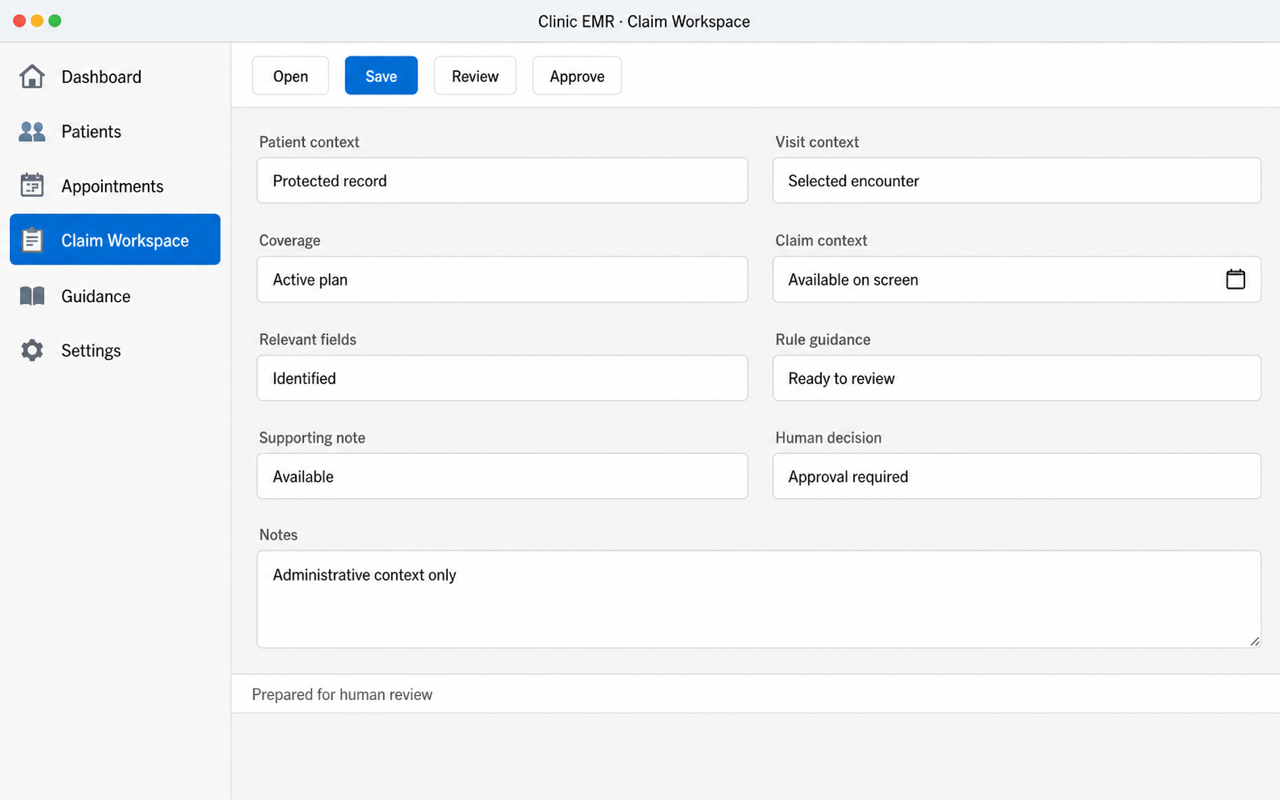
Conceptual workflow No patient data is shown.
The administrative gap
The work can be repetitive and highly specific to each site. Depending on the local workflow, staff may move between legacy interfaces and detailed claim guidance, then review the same information again before submission.
Legacy EMR screens and workflows vary between providers and sites.
Insurance claim rules can be detailed and may change over time.
Lookup, entry, review, and correction may add to administrative workload.
Depending on the site, claim review may involve repeated lookup, entry, checking, and correction across different systems.
Proposed workflow
The concept is intended to support selected steps within the visible workflow, with a person retaining responsibility for review and approval.
Use the visible EMR screen as context.
Identify potentially relevant fields and workflow state.
Surface potentially applicable guidance for review.
Prepare a possible next administrative action.
Require human review before any operational use.
Boundary FreeDoc is an early-stage administrative support concept. It is not presented as an autonomous system for clinical judgment, diagnosis, treatment, or claim submission.
Why FreeDoc
The initial concept explores working through the visible interface rather than depending on early EMR API integration.
Technical feasibility, configuration needs, and workflow fit would still require validation at each site.The proposed architecture is intended to keep core model inference on a dedicated clinic-side device.
This design does not by itself establish privacy, security, or regulatory compliance. Controls would need partner-specific review and validation.The concept is intended to present possible administrative next steps while keeping clinicians and administrators responsible for decisions.
Any operational use would require defined approval points, exception handling, and local validation. No regulatory certification is claimed.Core architecture
The proposed architecture would place core model inference on a dedicated clinic-side device, alongside the EMR already in use. This is a design goal that would need validation in each partner environment.
Access, logging, retention, masking, security controls, and jurisdiction-specific requirements would need to be defined and validated with each partner.
Proposed safeguards
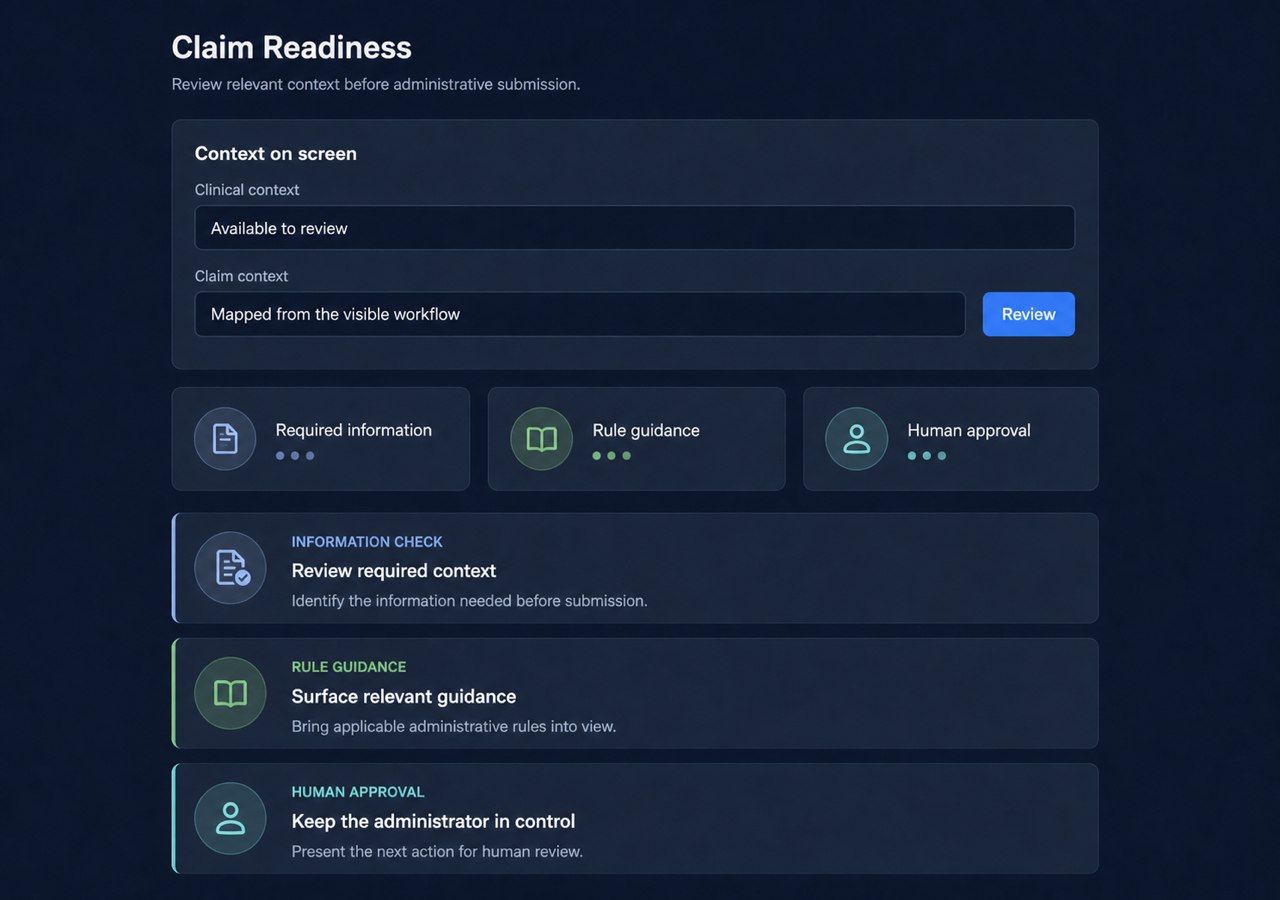
The current concept explores how screen context, rule guidance, verification, and human review could be combined in a controlled administrative workflow.
Design principle
Context checks and an action preview are included as design goals, not as evidence of production reliability.
Conceptual architecture. No claim is made about clinical performance, claim accuracy, regulatory compliance, or production readiness. Operational performance would need a limited, workflow-specific evaluation.
The public website describes design concepts only. Workflow details and validation scope are defined with each partner.
Current stage
The prototype visuals illustrate how screen context, claim guidance, and human review might work together. No production deployment or jurisdiction-specific readiness is claimed.
Partnership
We are looking for partners willing to help define the operating context and assess whether the concept is relevant before any implementation decision.
Select a candidate workflowStart with one administrative task worth exploring.
Define assumptions and boundariesMap risks, exceptions, and human review points.
Review local requirementsConsider regulatory, privacy, security, and data-handling needs early.
Plan a limited evaluationUse non-production or shadow-mode conditions where appropriate, without operational submission.
Learn togetherAssess relevance, exceptions, user feedback, and control requirements.
For Singapore, we are seeking local validation—not presenting a ready-to-deploy product. Any work would begin with local workflow, regulatory, privacy, and security review.

HayanMind is applying its software product, partner collaboration, and AI experience to this early-stage concept.
HayanMind's broader software experience should not be read as evidence of FreeDoc deployment, performance, or regulatory readiness.
A narrow first evaluation
A limited evaluation could help determine whether the concept fits the local workflow and what data, security, approval, and regulatory boundaries would be needed.
Do not include patient or medical information in an email to us.